In almost every agency I've worked at, across global brands, small studios, and everything in between, the same conversation eventually happens.
A senior leader sits across the table and says something like, "We do incredible work for our clients. Our team is exceptional. Our clients have been with us for years. So why isn't the account growing?"
It's a fair question.
And the answer is almost never about the work.
It's about trust. Specifically, what kind.
Because trust inside a client relationship isn't a single thing. It looks like a single thing. Clients either trust you or they don't, right? But it doesn't actually behave like one. It's three different currencies, earned different ways, spent for different things.
And most agencies are only earning one of them.
Why this matters now
Agency margins have been under pressure for a decade. Client churn is climbing. Procurement is shaping more relationships than CMOs are. Multi-year retainers are getting unbundled into project SOWs. The long arc of consolidation, both client-side and agency-side, keeps shortening the half-life of senior relationships.
In that environment, the question of how trust gets built has stopped being soft. It's the most commercial question an agency can ask.
Because the relationships that survive procurement reviews, leadership transitions, and budget cuts aren't the ones with the best work.
They're the ones with the deepest trust.
And the deepest trust isn't operational. It's something else.
The Three Trust Currencies
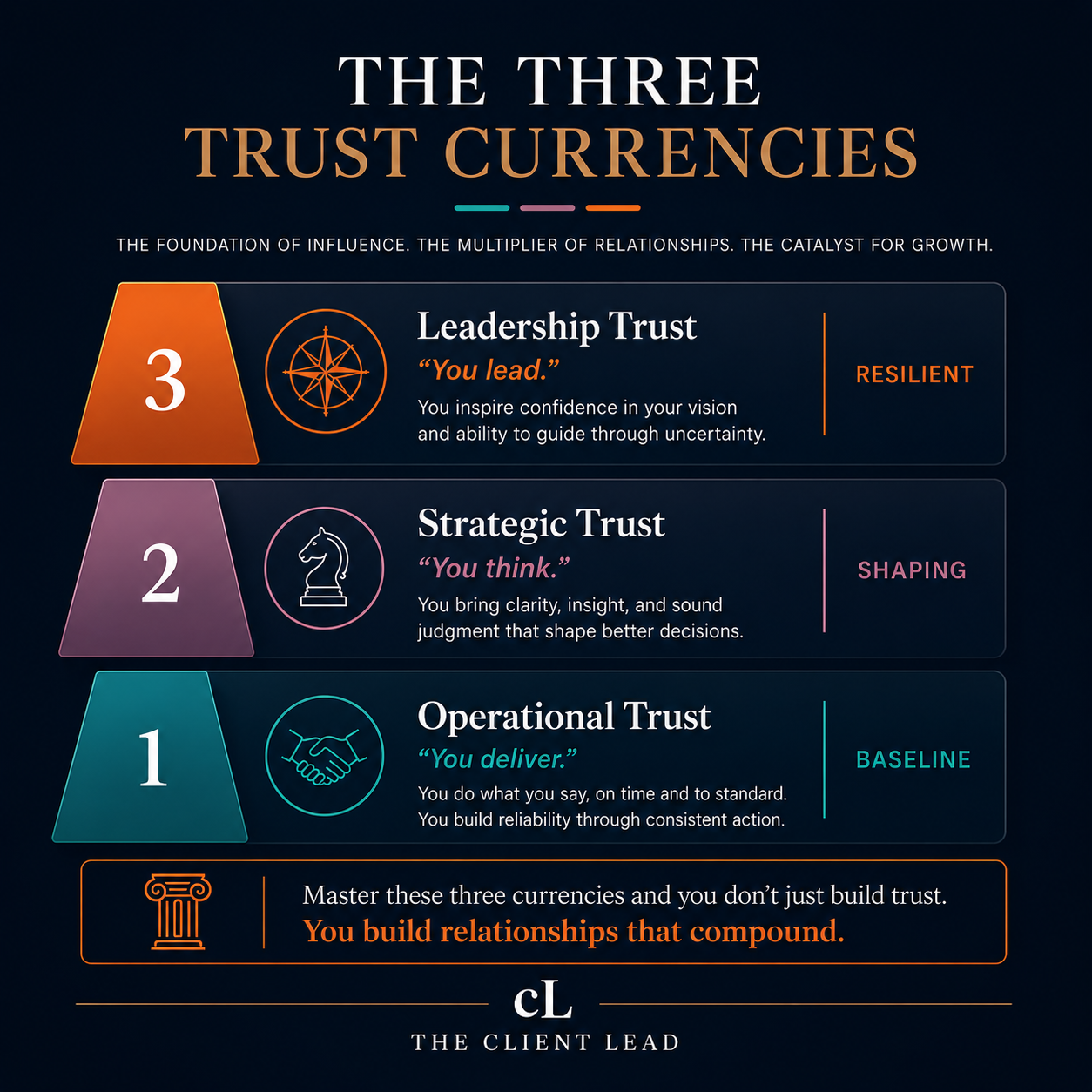
The framework is simple. The implications are sharp.
1Operational Trust: "You deliver."
This is the baseline. The floor.
Meetings happen on time. Decks land when promised. The work is solid. Briefs get interpreted correctly. Status reports show up. Email replies are quick. There are no surprises in the bill.
Junior teams build operational trust through reliability. Most agency operating models are built around earning it.
It is necessary. It is also the place where most client relationships plateau, and stay.
The trap of operational trust is that it becomes invisible once it's table stakes. The longer you do excellent operational work, the less additional relationship it earns you. You can't earn more trust by being even more on time. The currency stops compounding.
Signs you're stuck at this level:
- Every meeting is a status update
- You're informed, rarely consulted
- Briefs arrive fully formed; you respond rather than shape
- Your senior leaders rarely speak to their senior leaders without a fire to put out
2Strategic Trust: "You think."
This is when a client believes you understand their business well enough to shape it, not just service it.
Strategic trust is earned through point of view. Through pattern recognition across their category. Through the observation they hadn't made themselves. Through the question they didn't expect.
It's what gets you invited into the planning conversation, rather than briefed after it.
The behaviors that build it:
- Volunteering POV without being asked
- Bringing observations from adjacent industries or categories
- Asking the question that reframes the brief
- Telling them what you'd do if you were them, and being right often enough that they start asking
Strategic trust requires permission to be wrong sometimes. Teams that protect themselves by only offering safe, expected thinking never accumulate it.
The trap: confusing tenure with strategic trust. Being on the account for five years doesn't mean the client trusts your thinking. It might just mean they trust your reliability.
3Leadership Trust: "You lead."
The highest-leverage currency. The one that compounds the longest.
Leadership trust is earned when clients believe you can navigate ambiguity, manage competing internal priorities, and represent their interests even when they're not in the room.
It's what unlocks the calls that start with: "I need your read on something. Off the record."
It's what shows up when the client's CMO changes, and the new leader hears your name from her predecessor before she ever opens a brief. It's what protects the relationship when procurement runs a review, because the senior client picks up the phone to defend you before the spreadsheet does.
The behaviors that build it:
- Carrying weight outside your formal scope when the moment calls for it
- Handling conflict with grace, both with the client and within your own team
- Advocating for the client inside your agency, visibly
- Bringing calm and clarity to ambiguity, not anxiety
- Saying the hard thing. Early, privately, well.
The trap: confusing seniority with leadership trust. Plenty of VPs without leadership trust still lose the account in procurement reviews. Leadership trust isn't conferred by your title. It's earned in the moments that don't appear on the org chart.
A 90-second diagnostic
Pick one of your most important client relationships. Then sit with these:
- When the client has a problem that doesn't involve you, do they tell you about it?
- Are you in the room before strategy decisions are made, or briefed after?
- When the client's most senior leader is asked, "who do you trust at the agency?", what name comes up first, and is it the right one?
- When the relationship last hit turbulence, did the client call you, or did you find out by surprise?
- If your most senior client lead left the relationship tomorrow, what trust would walk out the door with them, and would any of it stay?
The answers tell you which currencies you're really earning. And which ones you've assumed you have, but haven't.
Why this matters for how you structure your team
Most account teams are built to deliver operational trust. The systems (status meetings, weekly check-ins, scope documents, project trackers) are designed for it.
Strategic and leadership trust have to be deliberately built. They don't happen as a byproduct of good work.
That has implications for how you staff, train, and operate:
- Operational trust scales with delivery systems. Strategic trust scales with capability and POV development. Leadership trust scales with seniority, exposure, and time.
- A team optimized only for delivery will never produce strategic trust at the rate the relationship needs.
- Leadership trust can't be delegated downwards. If your senior leaders aren't visible inside the relationship, without a fire to put out, leadership trust isn't being built.
- The currencies don't substitute for each other. Strategic brilliance can't compensate for unreliable delivery. Operational excellence can't compensate for strategic absence.
The healthiest relationships have all three running.
The most resilient ones have all three running across multiple people.
The compounding effect
Here's the part most agencies miss.
When all three trust currencies are present, the relationship becomes resilient in ways that the work alone can never make it.
- Procurement reviews don't threaten you, because the senior client defends you before the spreadsheet does.
- Leadership transitions don't reset the relationship to zero, because trust has been built across multiple people.
- Pricing conversations become easier, because the value you create is visible at all three levels.
- Scope conversations become collaborative, not transactional, because they happen on shared ground.
- New opportunities arrive unsolicited, because trust at the leadership tier surfaces opportunity that's not in any brief.
The agencies that grow with their clients through downturns, transitions, and category disruption aren't necessarily the ones with the best work.
They're the ones who treat trust as three different muscles to train. Not one general feeling to manage.
Client leadership is not built through visibility alone. It is built through the accumulation of trust.