I've read a lot of agency account growth plans over the years. I've also written my fair share. And I've come to a slightly uncomfortable conclusion: most of them aren't growth plans at all.
They look the part. They use the right template. They get a slot at the quarterly business review. Leadership nods. The deck gets saved to the shared drive. And then, for the most part, nothing happens.
That is the tell. A real growth plan changes what people do. A comfort document just reassures everyone that growth is being thought about.
What most account plans actually are
If you read most account plans closely, the same pattern shows up again and again:
- A list of agency capabilities the client hasn't bought yet
- Generic language about deepening the relationship
- No real point of view on the client's business
- No sense of timing or sequencing
- No owner with the authority or internal partnership to move it forward
That's not a growth plan. That's a wishlist with a header.
The distinction matters because the two documents are built from opposite starting points. An account plan is built from the agency's side of the table: our services, our capabilities, our revenue targets. A growth plan is built from the client's side: their business, their pressure, their next twelve months.
Same template. Completely different document.
The six dimensions that separate them
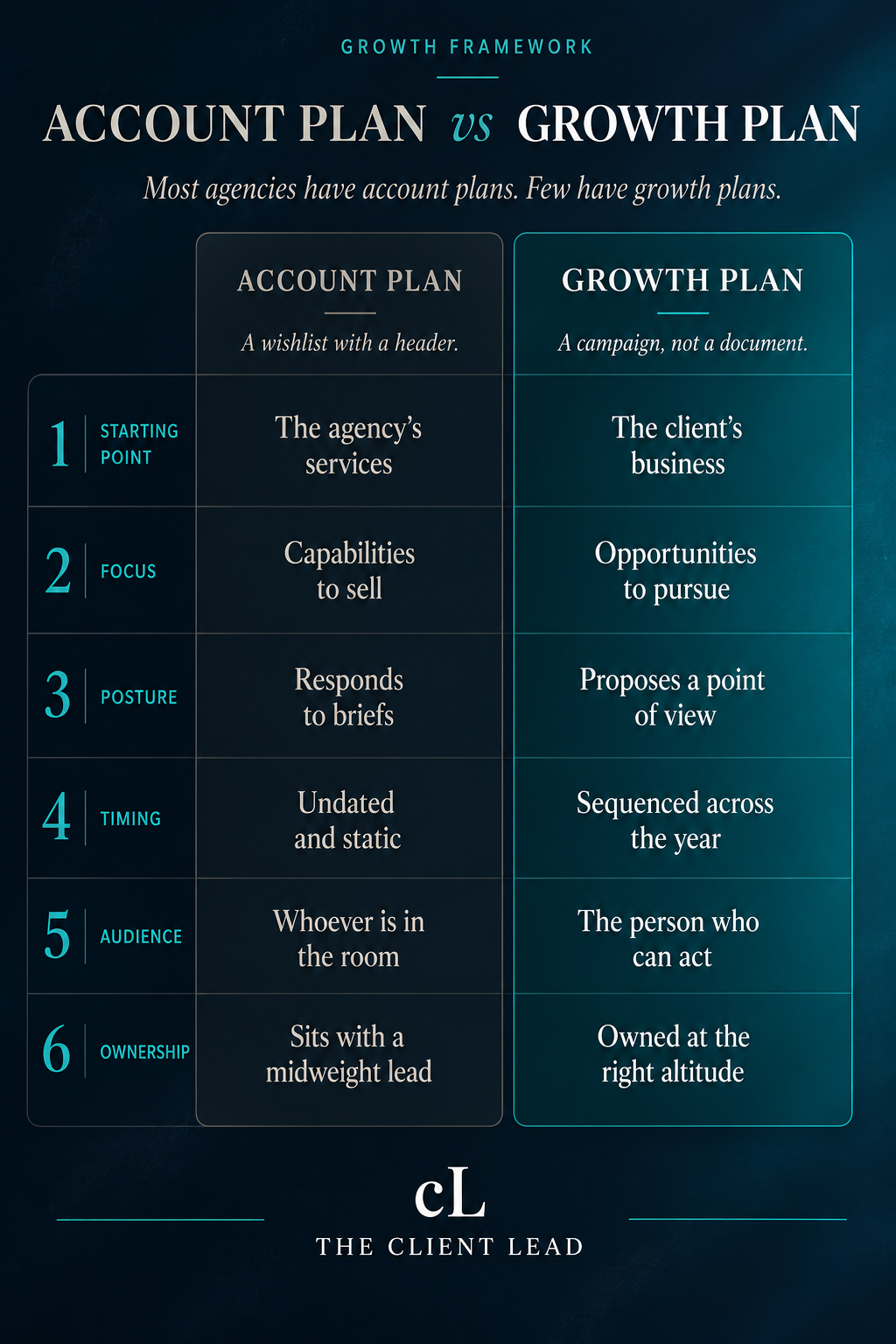
An account plan and a growth plan can look almost identical on the surface. The difference lives in six places. Here is each one, drawn out side by side.
1Starting point
An account plan starts with the agency. What do we sell, what hasn't this client bought, where is our revenue gap. A growth plan starts with the client. What is their growth pressure, where are they exposed, what is their CMO being measured on next year.
This sounds like a small reframe. It isn't. It changes every line that follows. When you start from the client's business, you stop asking "what else can we sell" and start asking "what does this client need to do, and what is our role in it."
If you cannot describe the client's commercial reality in two or three sentences without mentioning your agency, you do not have a growth plan yet. You have a guess.
2Focus
An account plan lists capabilities. We could do their microsite. We could pitch for their strategic positioning work. We could sell them a brand refresh. Each one is shaped like the agency.
A growth plan identifies opportunities, and opportunities are shaped like the client. Not "we could sell them more strategy" but "they have shifted budget into influencer and social and away from brand building, and there is a strategic role we could play in making that shift pay off."
The first is a capability looking for a home. The second is a client problem with a natural answer. Clients can feel the difference immediately.
3Posture
An account plan responds. It waits for the brief, then organizes the agency around it. A growth plan proposes. It is willing to say, "we think you should consider this, and here is why."
That willingness is the line between a vendor and a partner. Vendors respond well. Partners propose well. A growth plan with no point of view in it is not neutral. It is just a vendor relationship written down.
The point of view does not have to be right every time. It has to be considered, useful, and offered before it was asked for.
4Timing
Most account plans are undated. They describe a set of ambitions with no sense of when anything happens. Everything is, implicitly, for "this year."
A growth plan is sequenced. It knows the client's year has a shape: planning cycles, budget windows, leadership changes, brand moments. It places each conversation where it has the best chance of landing.
Raising a strategic idea two weeks after the budget is set is not bad luck. It is bad planning. Timing is not a detail of the growth plan. It is half of the strategy.
5Audience
An account plan is presented to whoever happens to be in the room, usually the day-to-day client contact. A growth plan is built around a contact strategy. It maps who inside the client can actually appreciate the idea and has the authority to move it.
This is where good thinking quietly dies. Earlier in my career I watched strong ideas stall, not because they were wrong, but because they never reached anyone with the appetite or the authority to act.
Getting the idea right is half the work. Getting it to the right person is the other half. A growth plan names that person.
6Ownership
An account plan often sits with a midweight lead. It gets built because the template asked for it, updated because the QBR is coming, and then set down.
A growth plan is owned at the right altitude. Someone senior enough to carry it into the rooms where it matters, hold the relationships it depends on, and keep it moving between the formal reviews.
Growth requires altitude. Without it, even a well-built plan slowly becomes a document again. The plan does not move itself. A person moves it.
What this looks like in practice
Take a CPG client. Same agency, same year, two versions of the plan.
The account plan says: the client currently buys design work. We have capabilities in design, innovation, and brand strategy they have not bought. The goal is to grow the account by 20 percent. The actions are to introduce and pitch a brand strategy project, and watch for briefs.
The growth plan says something different. The client's core category surged through the pandemic and has since cooled, and last year's numbers made that impossible to ignore inside the business. The brand lead has been asked to find growth that does not depend on the core holding up, and she needs a credible answer before next year's innovation planning cycle. The opportunity is not "pitch a brand strategy project." It is "help her find and shape the brand's next growth horizon." The point of view is that this is an adjacency and innovation problem, not just a design one, and that it calls for strategy and innovation thinking. The sequence starts with a short opportunity-mapping session before the innovation roadmap is locked, so the thinking is in her hands while the budget is still moving. The plan is owned by the client partner, who already has a relationship with the brand lead, not by the Sr. account manager who runs the weekly status call.
Both plans might end up selling a brand strategy project. Only one of them earns the right to.
Is your account plan actually a growth plan?
Take your most important account. Read its current plan against these six questions.
- Could a client read the first page and recognize their own business in it, before your agency is mentioned?
- Does it name a real opportunity in the client's business, or a capability you would like to sell?
- Is there a clear point of view in it, something you are proposing rather than waiting to be asked?
- Does it say when each conversation should happen, and why then?
- Does it name the specific person who can act on it, and how you reach them?
- Is it owned by someone senior enough to move it between reviews?
A real growth plan passes all six. Most account plans pass one or two. The gap between those two scores is, more often than not, the gap between an agency that grows with its clients and one that quietly stagnates inside them.
An account plan is built from the agency's side of the table. A growth plan is built from the client's. That single shift is the whole difference.